Craftsmanship
The Timeless Beauty of Live Edge Furniture
Where raw wood meets refined design in contemporary furniture making.
Read More →How contemporary artists are blurring the lines between sculpture and furniture to create pieces that serve both purposes beautifully.

By Vik Chadha
Founder, ArtfullyBuilt
There was a time when furniture was furniture and sculpture was sculpture. A chair existed to be sat in. A sculpture existed to be admired. But today, a new generation of artists and designers is dismantling that boundary, creating works that demand to be both used and contemplated in equal measure.
The idea of furniture as art is not entirely new. The Art Nouveau movement of the late 19th century saw designers like Hector Guimard and Louis Majorelle creating sinuous, organic forms that elevated everyday objects into works of beauty. In the mid-20th century, designers like Isamu Noguchi and George Nakashima brought sculptural sensibilities to functional objects, proving that utility and artistry could coexist.
What distinguishes today's movement is its radical ambition. Contemporary artists aren't simply adding decorative flourishes to conventional forms—they're reimagining what furniture can be from the ground up, treating each piece as a sculptural challenge with a functional constraint.
The strongest pieces are neither furniture that happens to look like sculpture nor sculpture that happens to function as furniture. Each is a conversation between form and purpose in which neither dominates.
This philosophy represents a fundamental shift in how we think about the objects in our homes. When a dining table is also a sculptural statement, it transforms the act of eating into something more deliberate, more conscious. When a bookshelf is a work of art, it elevates the simple act of storing books into an act of curation.
The result is living spaces that feel less like showrooms and more like personal galleries, where every object tells a story and serves a purpose.
Much of what makes sculptural furniture possible today is the extraordinary range of materials and techniques available to contemporary makers. Advances in metalworking, wood bending, resin casting, and 3D printing have expanded the vocabulary of form far beyond what earlier generations could imagine.
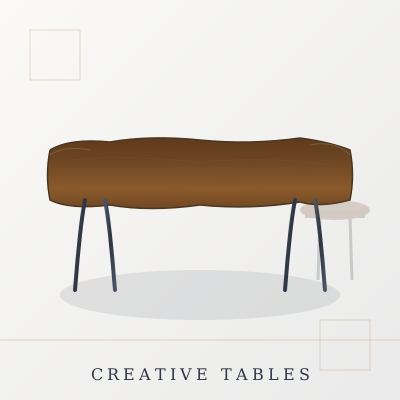
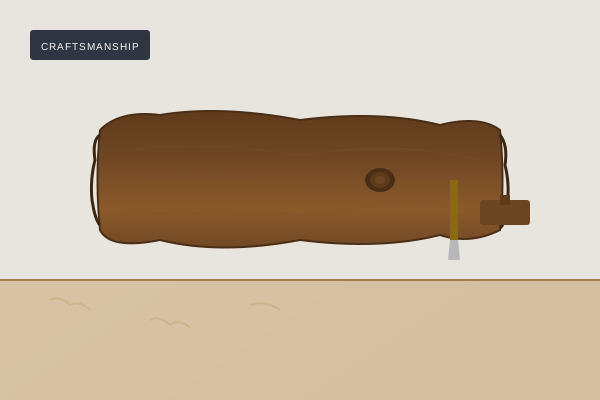
Live edge slabs, steam-bent forms, and charred finishes (shou sugi ban) allow wood to take on sculptural qualities that challenge our expectations. A live edge dining table preserves the tree's natural silhouette, making each meal a communion with the organic world.
Hand-forged steel and cast bronze enable forms that are both structurally sound and visually dramatic. Contemporary metalworkers create chairs that appear to defy gravity, tables that seem to flow like liquid, and shelving units that resemble abstract compositions.
Perhaps the most exciting frontier is the combination of materials—resin and wood, glass and metal, stone and fiber. These hybrid pieces create visual tension and surprise, forcing the viewer to reconsider what's possible in functional design.
Incorporating sculptural furniture into a home requires a different approach than conventional interior design. These pieces demand space to breathe and be appreciated. They work best when given room to be the focal point, rather than crowded among competing elements.
Interior designer Clara Bennet advises a "less is more" philosophy: "One extraordinary sculptural piece in a room is worth more than ten conventional ones. Let it anchor the space, and let everything else support it quietly."
This approach also has practical benefits. Investing in fewer, higher-quality pieces means less clutter, more visual calm, and a home that feels intentionally curated rather than haphazardly filled.
Sculptural furniture occupies a unique position in the market. Unlike mass-produced furniture that depreciates the moment it leaves the showroom, well-crafted sculptural pieces often appreciate in value over time, much like fine art.
Collectors are increasingly recognizing functional art as a legitimate category, with major auction houses now dedicating sales to contemporary design. Pieces by established artist-designers routinely fetch prices comparable to traditional sculpture and painting.
But beyond financial value, sculptural furniture offers something money can't easily quantify: the daily pleasure of living with objects that are both useful and beautiful, that elevate the mundane into the meaningful.
As technology continues to advance and sustainability becomes an ever-greater priority, the field of sculptural furniture is evolving in exciting directions. Digital fabrication tools are enabling forms that were previously impossible, while a renewed emphasis on local materials and traditional techniques is grounding the work in craft and place.
The intersection of art and function is no longer a niche concern—it's becoming the defining aesthetic of contemporary living. As more people seek meaning and beauty in their everyday surroundings, sculptural furniture offers a compelling answer: objects that don't just fill a space, but transform it.
Vik Chadha is the founder of ArtfullyBuilt, a curated marketplace for functional art furniture and unique home decor. His passion for functional art furniture began when furnishing his own home, and he has since dedicated himself to championing handcrafted design and the artisans behind it.
Where raw wood meets refined design in contemporary furniture making.
Read More →
Ancient metalworking techniques for contemporary functional art.
Read More →
Build a valuable collection with investment and care insights.
Read More →Get the latest design insights, craft stories, and exclusive content delivered to your inbox every week.
Join 8,500+ design enthusiasts. No spam, unsubscribe at any time.